
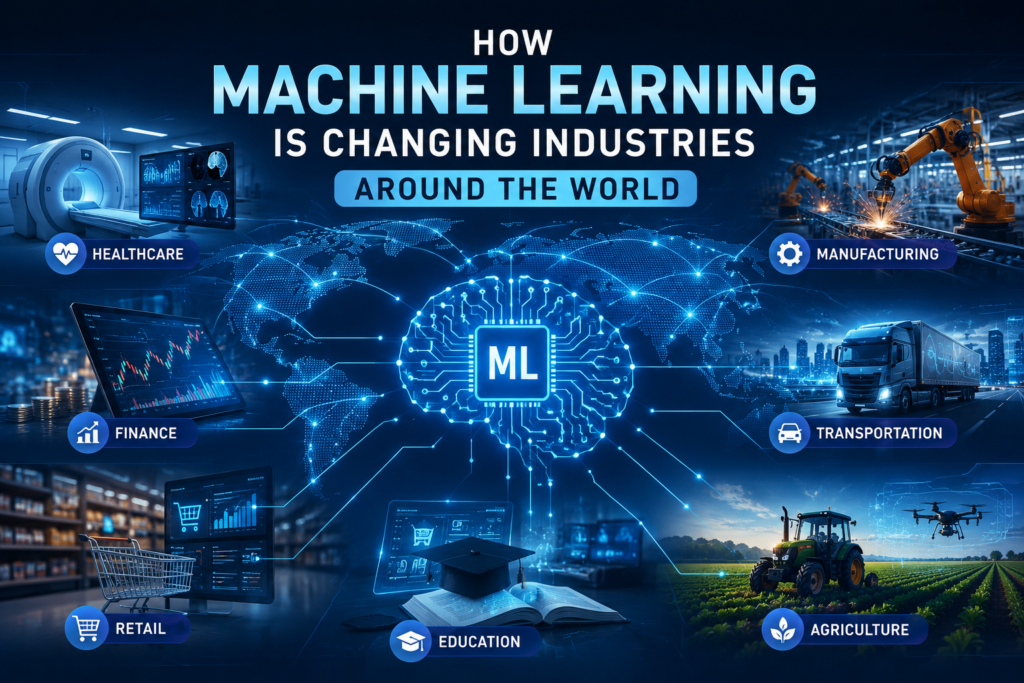

Machine Learning (ML) has become one of the most transformative technologies of the 21st century. As a branch of Artificial Intelligence (AI), machine learning enables computers to learn from data, identify patterns, and make decisions with minimal human intervention. What once seemed like futuristic technology is now a part of everyday life, powering everything from online shopping recommendations and voice assistants to self-driving cars and medical diagnostics.
Businesses across industries are increasingly adopting machine learning to improve efficiency, reduce costs, enhance customer experiences, and gain valuable insights from large amounts of data. Whether it’s healthcare, finance, manufacturing, retail, education, or agriculture, machine learning is reshaping how organizations operate and compete in the digital era.
In this article, we’ll explore what machine learning is, how it works, its real-world applications across different industries, the benefits it offers, challenges businesses face when implementing it, and what the future holds for this rapidly evolving technology.
What Is Machine Learning?
Machine Learning is a subset of Artificial Intelligence that allows computers to learn from historical data without being explicitly programmed for every task. Instead of following fixed rules, machine learning algorithms analyze data, recognize patterns, and improve their predictions over time.
For example, when Netflix recommends movies or Spotify suggests songs based on your listening habits, machine learning algorithms analyze your behavior and compare it with millions of other users to make personalized recommendations.
Unlike traditional software that follows predefined instructions, machine learning systems continuously improve as they process more data.
How Machine Learning Works
Machine learning follows a structured process that includes several key stages:
1. Data Collection
The first step is gathering data from various sources such as websites, mobile applications, sensors, databases, or customer interactions.
2. Data Preparation
Collected data is cleaned by removing duplicate records, correcting errors, and organizing it into a usable format.
3. Model Training
The machine learning algorithm studies historical data to identify patterns and relationships.
4. Testing
The model is tested using new data to evaluate its accuracy and reliability.
5. Deployment
Once the model performs well, it is integrated into business applications where it makes predictions or automates decisions.
6. Continuous Learning
As more data becomes available, the model can be retrained to improve its performance over time.
Types of Machine Learning
There are four primary types of machine learning.
1. Supervised Learning
Supervised learning uses labeled data where the correct answers are already known.
Examples include:
- Email spam detection
- House price prediction
- Sales forecasting
- Credit scoring
2. Unsupervised Learning
This method analyzes unlabeled data to discover hidden patterns.
Common uses include:
- Customer segmentation
- Market research
- Product recommendations
- Fraud detection
3. Reinforcement Learning
In reinforcement learning, algorithms learn by interacting with an environment and receiving rewards or penalties based on their actions.
Applications include:
- Robotics
- Autonomous vehicles
- Video game AI
- Industrial automation
4. Semi-Supervised Learning
This combines a small amount of labeled data with a larger amount of unlabeled data, making it useful when labeled datasets are limited or expensive to create.
How Machine Learning Is Transforming Different Industries
1. Healthcare
Healthcare has experienced one of the biggest impacts from machine learning.
Applications include:
- Early disease detection
- Medical image analysis
- Personalized treatment plans
- Drug discovery
- Hospital resource management
- Virtual health assistants
Machine learning helps doctors analyze medical images such as X-rays, MRIs, and CT scans with greater speed and accuracy, supporting earlier diagnosis and improved patient care.
2. Banking and Finance
Financial institutions use machine learning to improve security and customer service.
Popular applications include:
- Fraud detection
- Credit risk assessment
- Investment analysis
- Customer support chatbots
- Algorithmic trading
- Loan approval automation
Banks can detect unusual transactions in real time, helping reduce fraud and protect customer accounts.
3. Retail and E-Commerce
Retail companies use machine learning to personalize shopping experiences.
Examples include:
- Product recommendations
- Dynamic pricing
- Demand forecasting
- Inventory management
- Customer behavior analysis
- Personalized marketing campaigns
Online stores can recommend products based on browsing history, purchase patterns, and customer preferences, increasing engagement and sales.
4. Manufacturing
Manufacturers use machine learning to improve production efficiency and reduce downtime.
Applications include:
- Predictive maintenance
- Quality control
- Supply chain optimization
- Production scheduling
- Equipment monitoring
- Robotics automation
Predictive maintenance allows businesses to repair machinery before failures occur, minimizing costly interruptions.
5. Agriculture
Modern farming has become increasingly data-driven with machine learning.
Farmers use it for:
- Crop health monitoring
- Yield prediction
- Weather forecasting
- Pest detection
- Smart irrigation
- Soil analysis
These technologies help increase productivity while reducing water usage and waste.
6. Education
Educational institutions use machine learning to create personalized learning experiences.
Examples include:
- Adaptive learning platforms
- Automated grading
- Student performance analysis
- Virtual tutors
- Language learning applications
Students receive customized content based on their strengths, weaknesses, and learning pace.
7. Transportation and Logistics
Machine learning improves transportation systems by making them more efficient and reliable.
Applications include:
- Route optimization
- Traffic prediction
- Fleet management
- Delivery scheduling
- Autonomous vehicles
Logistics companies use machine learning to reduce fuel costs and improve delivery times.
8. Marketing
Digital marketing relies heavily on machine learning to understand customer behavior.
Businesses use it for:
- Customer segmentation
- Email marketing optimization
- Personalized advertisements
- Social media analytics
- Content recommendations
- Lead scoring
These insights help marketers deliver more relevant campaigns and improve return on investment.
Benefits of Machine Learning
Machine learning offers numerous advantages for businesses and organizations.
Increased Efficiency
Automating repetitive tasks saves time and allows employees to focus on higher-value work.
Better Decision-Making
Machine learning analyzes vast amounts of data quickly, providing insights that support smarter business decisions.
Improved Customer Experience
Personalized recommendations, faster support, and tailored services increase customer satisfaction and loyalty.
Cost Reduction
Automation reduces manual effort, minimizes errors, and optimizes resource usage, leading to lower operational costs.
Enhanced Security
Machine learning can detect suspicious activity, helping organizations respond to threats more effectively.
Scalability
As businesses grow, machine learning systems can handle larger datasets and more complex tasks without significant changes to infrastructure.
Challenges of Machine Learning
Despite its benefits, machine learning also presents several challenges.
High-Quality Data Requirements
Machine learning models depend on accurate and relevant data. Poor-quality data can lead to unreliable predictions.
Privacy and Security
Organizations must ensure that customer data is collected, stored, and processed responsibly while complying with data protection regulations.
High Implementation Costs
Developing and maintaining machine learning systems often requires investment in technology, infrastructure, and skilled professionals.
Bias in Algorithms
If training data contains bias, the resulting model may produce unfair or inaccurate outcomes. Regular testing and monitoring are essential.
Integration Complexity
Integrating machine learning into existing business systems can be technically challenging and may require significant planning.
The Future of Machine Learning
Machine learning continues to evolve rapidly and is expected to play an even greater role in the coming years.
Future trends include:
- More advanced generative AI applications
- Improved healthcare diagnostics
- Smarter autonomous vehicles
- AI-powered cybersecurity solutions
- Predictive maintenance across industries
- Enhanced customer service through intelligent virtual assistants
- Greater use of edge computing for faster real-time decision-making
As computing power increases and access to data expands, machine learning will become more accessible to businesses of all sizes.
Best Practices for Businesses Adopting Machine Learning
To successfully implement machine learning, organizations should:
- Define clear business objectives before starting projects.
- Collect and maintain high-quality data.
- Start with small pilot projects before scaling.
- Ensure transparency and fairness in AI models.
- Train employees to work effectively with AI-powered tools.
- Monitor model performance regularly and update models as new data becomes available.
- Prioritize cybersecurity and data privacy throughout the implementation process.
Conclusion
Machine learning is no longer a futuristic concept—it is a powerful technology transforming industries around the world. From improving healthcare outcomes and enhancing financial security to optimizing manufacturing processes and delivering personalized customer experiences, its impact is both broad and profound.
For businesses, adopting machine learning can lead to increased efficiency, smarter decision-making, lower costs, and stronger competitiveness. However, successful implementation requires quality data, skilled teams, ethical practices, and a clear understanding of business goals.
As machine learning technology continues to advance, organizations that embrace it responsibly will be better positioned to innovate, adapt, and thrive in an increasingly digital economy. Whether you are a small business owner, a student, or an enterprise leader, understanding machine learning today is an investment in the future of technology and business success.